At a Glance
Industry
Life Insurance
Role
Developed WAEPA’s lead-generation strategy from scratch and led the build across internal teams and external partners
Timeline
Experimentation from 2020 · core system 2021–2022 · expanded and improved through 2026.
scope
OptInMonster · Microsoft Dynamics CRM · Zapier · Google · Facebook · Email & nurture · SEO and content
Results
1,359% growth in leads from all sources.
1,361% growth in leads from paid digital
80% reduction in CPL
I developed WAEPA’s lead-generation strategy from scratch, with initial experimentation beginning in 2020 and the core system taking shape in 2021–2022. I continued expanding and improving it through 2026.
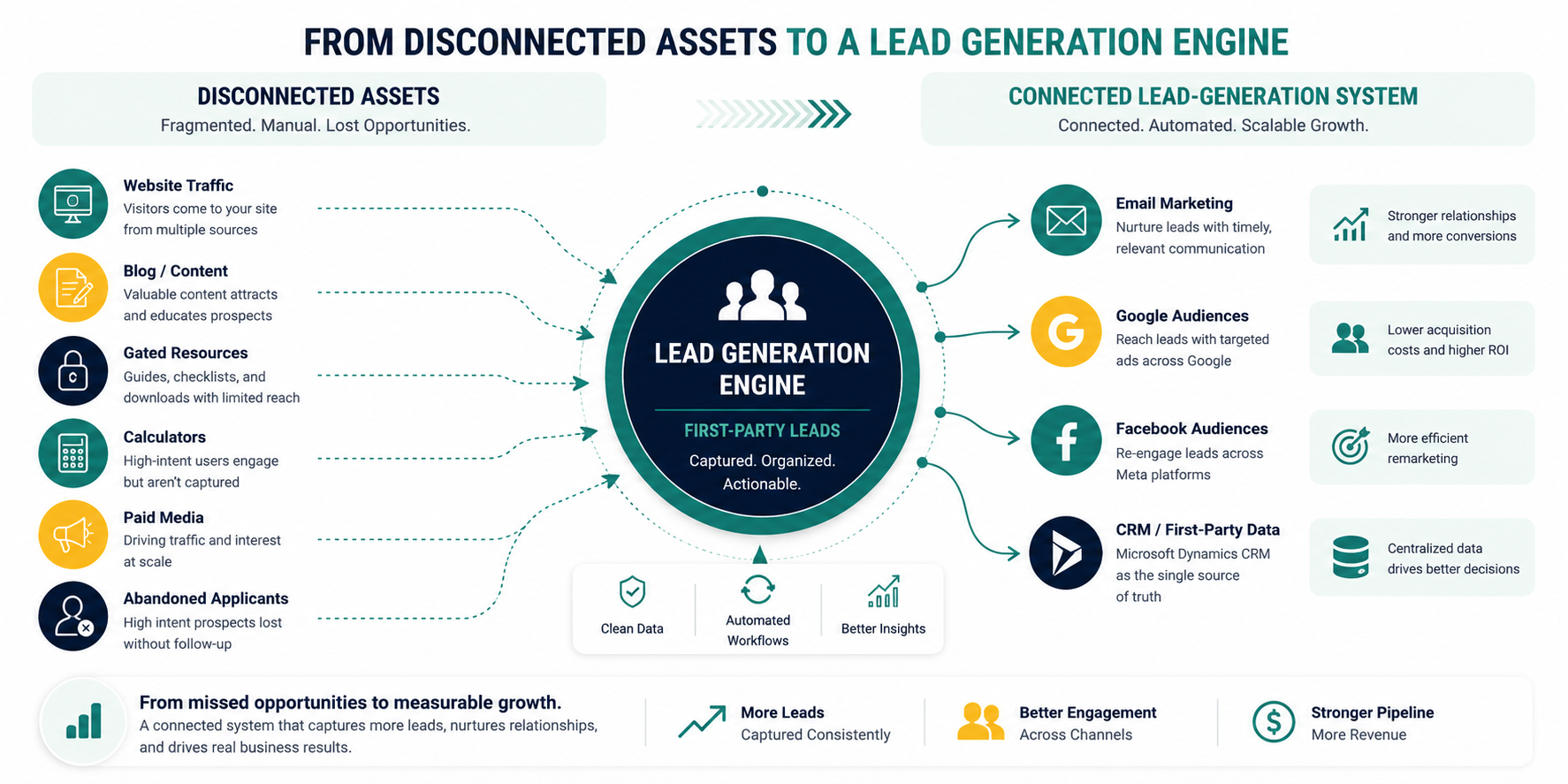
The result was a system in which website traffic, content, paid media, calculators, and first-party data could all contribute to a consistent flow of new leads.
When I joined WAEPA, lead generation was not a meaningful part of the digital marketing strategy. The organization primarily acquired leads through third-party providers, while organic lead capture on the website was extremely limited.
The Starting Point
before
- Lead generation primarily depended on third-party purchased leads
- Limited opportunities to capture website visitors
- Newsletter signup existed on only one page
- Gated content was not heavily promoted
- Leads were not consistently connected to downstream marketing channels
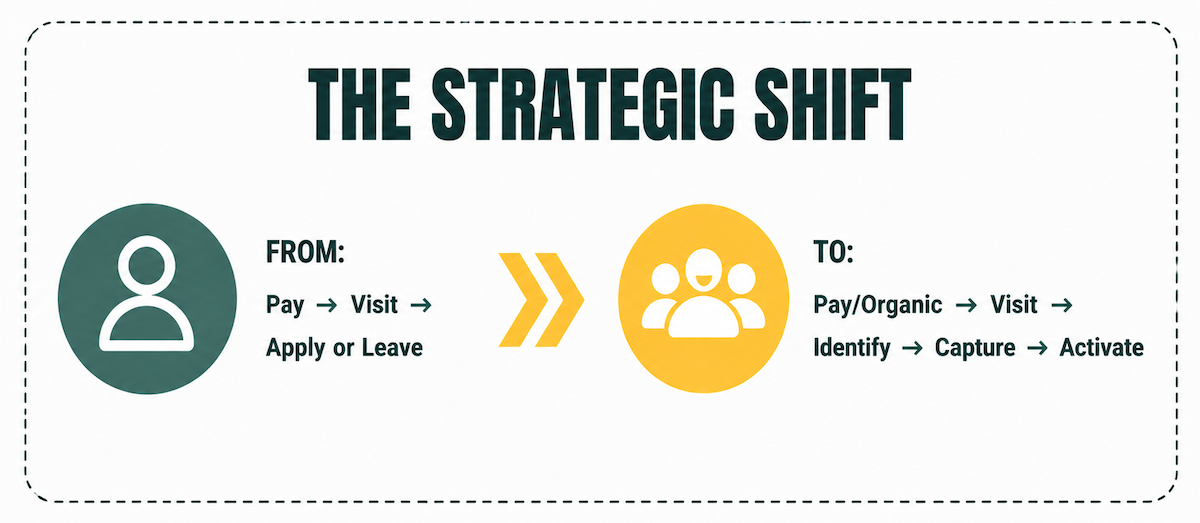
- Paid traffic was largely treated as “apply or leave”
A newsletter signup existed on one page, and some guides could be downloaded in exchange for contact information, but these opportunities were not prominently promoted or integrated into a broader acquisition strategy.
If someone arrived through paid advertising but was not ready to apply, much of the value of acquiring that visitor was lost. WAEPA had already paid to reach the prospect, yet had no reliable way to continue the relationship without spending again to reacquire them.
This created a fundamental problem: paid media was too often a binary proposition—apply or leave.
I saw an opportunity to change that by building a system that could consistently capture prospects who were interested but not yet ready to apply.
The opportunity wasn’t necessarily to create more marketing assets. WAEPA already had valuable content, guides, checklists, calculators, website traffic, and prospects who had demonstrated interest.
The bigger opportunity was to connect these existing resources to a deliberate lead-generation strategy.
I recognized that different visitors would have different levels of intent. Someone reading an educational article might be willing to download a guide, while someone using a product calculator might be much closer to a purchase decision. Someone who started an application and abandoned it had demonstrated even stronger intent.
lower intent
Reading an educational article
Willing to download a guide
Higher intent
Using a product calculator
Much closer to a purchase decision
Strongest intent
Started an application and abandoned it
Already demonstrated strong intent
Rather than requiring every visitor to take the final action of applying, I saw an opportunity to create additional ways for prospects to identify themselves and then make those prospects available for future marketing.
This approach could also make paid media more efficient. If WAEPA paid to bring someone to the website and that person wasn’t ready to apply, capturing their information created an opportunity to continue reaching them through email or first-party audience activation without paying to acquire that person again.
I developed WAEPA’s lead-generation strategy from scratch, with initial experimentation beginning in 2020 and the core system taking shape in 2021–2022. I continued expanding and improving it through 2026.
The strategy centered on three principles:
01
Capture more existing demand
Create additional opportunities for visitors to identify themselves without requiring an immediate application.
02
Activate existing assets
Turn content, guides, checklists, calculators, and high-intent website traffic into recurring lead-generation opportunities rather than treating them solely as informational resources.
03
make leads actionable
Ensure leads could move quickly from the website or other sources into Microsoft Dynamics CRM and then into the marketing channels where they could be used.
This transformed lead generation from a collection of isolated tactics into an interconnected system.
Expanding Website Lead Capture
I expanded lead-generation opportunities across the website, focusing particularly on three high-impact initiatives.
OptInMonster product-page popups
Created a secondary conversion path for high-intent visitors who were not ready to apply. Rather than losing those visitors, we could capture their information and reconnect with them later. The program ultimately generated thousands of leads each year.
Featured gated resources
Surfaced relevant guides and other content directly within blog and resource pages, expanding gated content beyond its previous limited use. Turned existing content and organic traffic into recurring lead-generation opportunities.
Save My Quote on calculators
Added a lead-capture path to calculators for prospects actively researching products but not yet ready to apply. Captured prospects demonstrating meaningful product interest before they reached the application stage.
I also identified additional opportunities, including gating checklists and routing Contact Us submissions into the CRM.
in the product
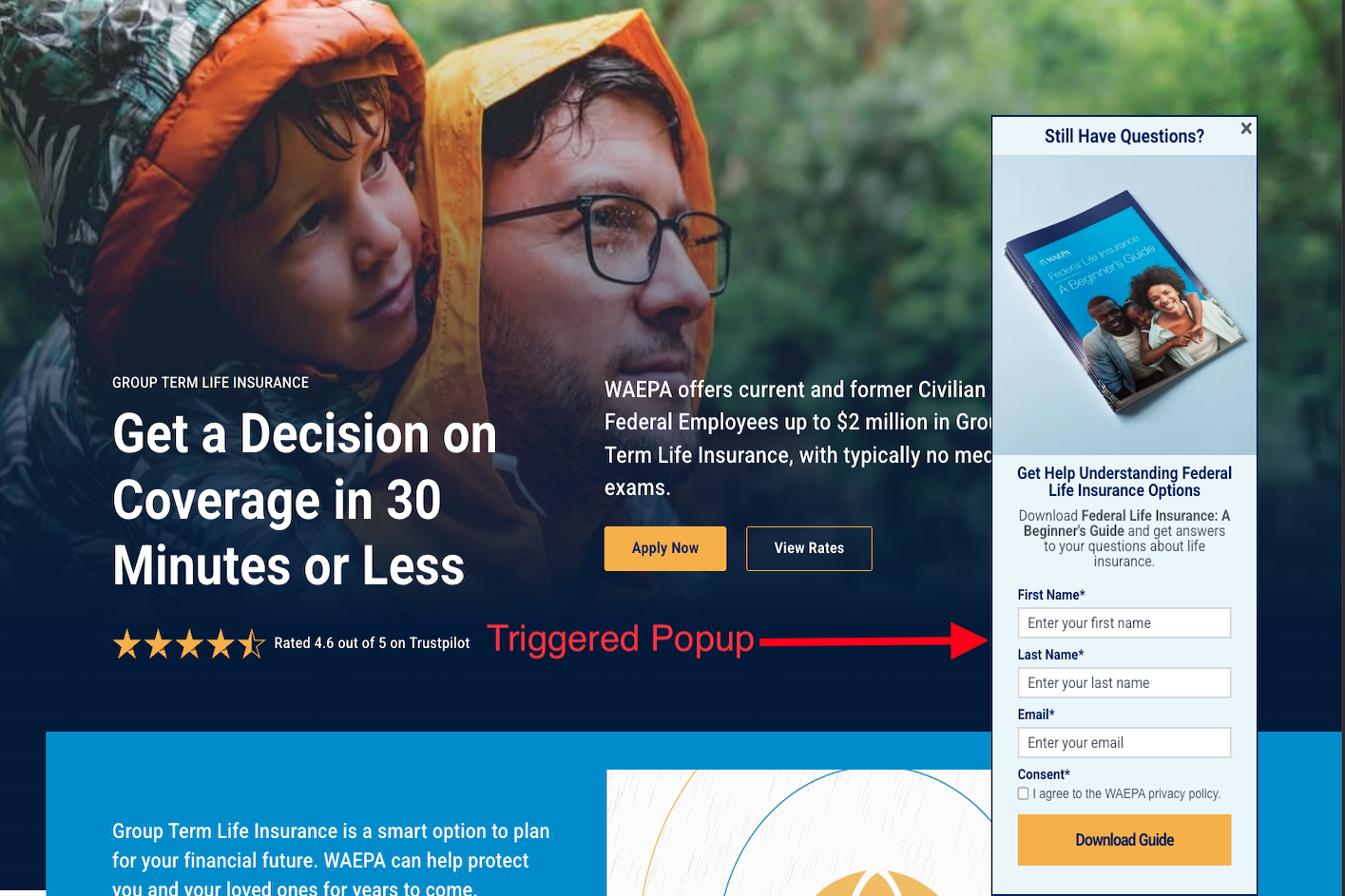
OptinMonster popup — product-page exit and scroll triggers.

Featured gated resource— inline block on blog and resource pages.
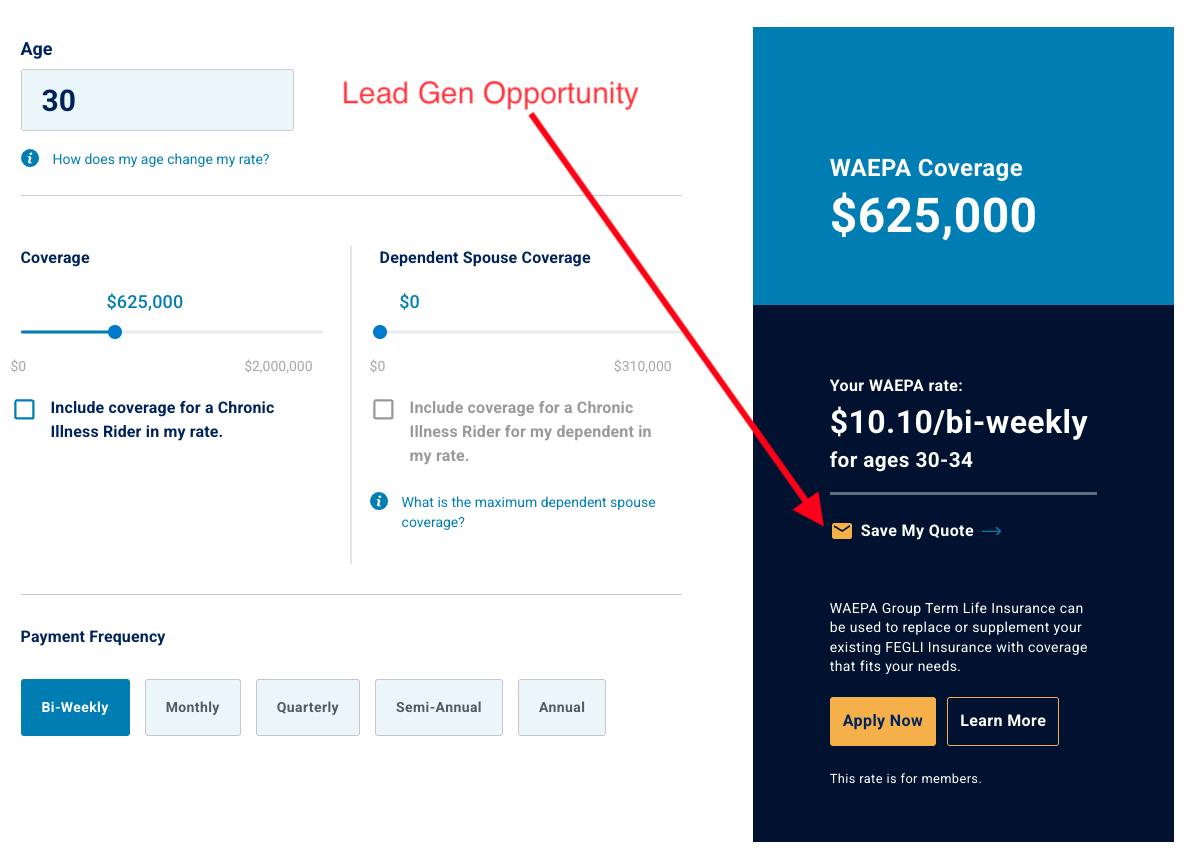
Save My Quote — capture step on the rate calculator.
Connecting the Lead Infrastructure
Generating leads only created value if the organization could capture and act on them efficiently. I therefore worked with internal teams and external partners to connect website forms and calculators directly to Microsoft Dynamics CRM.
I also implemented Zapier integrations between the CRM and advertising platforms, enabling first-party lead audiences to be automatically synchronized with Google and Facebook. These integrations reduced manual work and shortened the time between lead capture and activation.
How A Lead Moves
Popups
Gated Resources
Calculators
Abandoned Applicants
Paid & organic campaigns
Microsoft Dynamics CRM
Daily automated imports, mapped and validated
Email & nurture programs
Google Audiences
Facebook Audiences
Zapier integrations sync first-party audiences automatically
Turning Abandoned Applicants into an Actionable Lead Source
One of the most valuable opportunities I identified was abandoned applicants.
WAEPA was receiving a spreadsheet containing several hundred abandoned applicants per month, but these leads were manually imported only once or twice a month. I recognized that these prospects represented a significant source of first-party demand because they had already demonstrated strong intent.
before
manual import, once or twice a month
after
daily automated imports into the crm
I advocated for a better process, ultimately helping move the organization to daily automated imports into the CRM. I supported the technical implementation and validation, reviewing data field mappings and data quality to ensure the information was flowing correctly.
Once the data became consistently available, I helped expand how the audience could be activated. Abandoned applicants could be incorporated into email communications and a dedicated nurture program, while Zapier integrations enabled the audience to be pushed into dedicated Google and Facebook campaigns with messaging tailored to application abandoners.
Adding Paid Acquisition
I also created lead-generation campaigns within paid digital channels, including Facebook and Google, while optimizing SEO and content to generate leads from organic traffic.
The result was a system in which website traffic, content, paid media, calculators, and first-party data could all contribute to a consistent flow of new leads.
The system produced substantial growth in both lead volume and acquisition efficiency.
Growth in total website-generated leads, increasing from 843 in 2019 to 12,303 in 2025.
Growth in leads generated through paid digital, increasing from 242 to 3,536.
Reduction in paid-digital cost per lead, falling from $1,883 in 2022 to $375 in 2025.
Website-generated leads
Paid-Digital Cost Per Lead
The broader digital transformation also contributed to 99% growth in applications, 59% growth in new policies, and 27% growth in annual revenue over five years.
Building the system required coordinating across multiple teams, vendors, and technologies. Several integrations involved different lead sources and complicated technical requirements, and keeping projects moving required persistent cross-functional coordination, data mapping, testing, and validation.
Another constraint was creative and content capacity. Generating demand for gated resources required new ads and content assets, but the team had limited capacity to continuously produce the volume of creative needed to maximize every opportunity.
Finally, lead generation required a shift in mindset. Applications were the organization’s immediate and most visible business objective, so it could be challenging to demonstrate the value of capturing someone who was not yet ready to apply. I had to advocate for lead generation as a complementary acquisition strategy—not a replacement for applications—and demonstrate how capturing prospects could make existing marketing investments work harder.
The biggest lesson was that scalable growth doesn’t always require creating something entirely new. Often, the opportunity is to identify value that already exists and build the connections necessary to capture it.
WAEPA already had content, calculators, website traffic, paid media, and thousands of prospects interacting with its digital properties. The missing piece was a strategy and infrastructure for consistently turning those resources into first-party leads.
By connecting those pieces, I helped transform lead generation from a limited, largely manual activity into a recurring acquisition system.
The biggest opportunity isn’t always creating something new. Sometimes it’s connecting what you already have.”
The most important outcome wasn’t any individual popup, gated asset, or integration. It was building a lead-generation machine that could continuously create new opportunities from the marketing activity WAEPA was already investing in—and do so at increasing scale and efficiency.
Need Help building your growth engine?
If your digital program needs the same kind of full-funnel strategy, measurement, and cross-team execution — let’s talk.